Some artists paint what they see. Others paint what they dream. Myroslava Perevalska paints what she feels, and, more importantly, what she fears losing. In a world rushing forward, she is an artist who asks us to slow down, to breathe, to see before the colours fade, before the emotions slip away, before time moves beyond our grasp.
When we spoke, she described her connection to art in a way I had never heard before. “ think of myself as a fish,” she told me. “ fish that doesn’ question the water, that doesn’ think about how deep it swims. It just exists.” Art is her element, her lifeblood, and her way of understanding the world. It’ why, even as war reshapes the reality around her, she continues to create, not just as a form of resistance but as a way to document the truth as she experiences it.
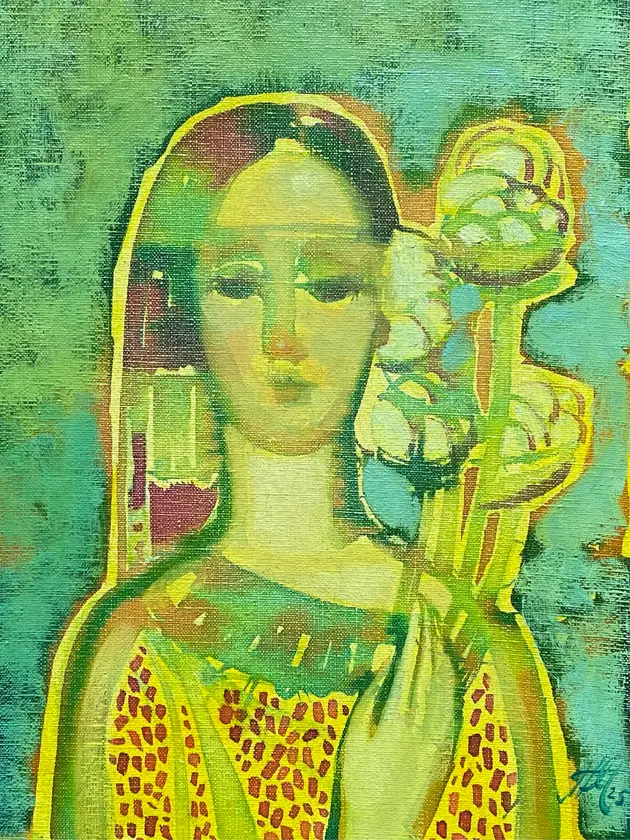
Her paintings are immediately recognisable, figures emerging from bold, urgent strokes of red, white, and black. Red, she told me, is the colour of life, of passion, of survival. It pulses through her work, a constant heartbeat. But it is also the colour she fears losing. “ greatest happiness,” she said, referencing Borges, “ when a blind man dreams of red.” The idea of losing that sensation, of not being able to feel the depth of colour, is her deepest fear. But instead of running from it, she embraces it, pours it into her canvases, ensuring that even if time erodes memory, the intensity of her vision remains.
As we talked, her thoughts spiralled outward - philosophy, history, technology, even the fate of humanity. “ are all on the Titanic,” she told me. “ comfortable but unaware of what’ coming.” The world is changing too quickly. Wars, pandemics, artificial intelligence, isolation. She fears we are forgetting how to truly be present. That people are becoming less human. She sees this loss reflected in modern art, how simple narratives and raw emotion are disappearing, replaced by a detachment from the soul of creation.
Where were you transported by this artwork?
Contribute your perspective to the community & earn rewards. Leave your reflection below.
Myroslava Perevalska
Artist from Ukraine
Some artists paint what they see. Others paint what they dream. Myroslava Perevalska paints what she feels, and, more importantly, what she fears losing. In a world rushing forward, she is an artist who asks us to slow down, to breathe, to see before the colours fade, before the emotions slip away, before time moves beyond our grasp.
When we spoke, she described her connection to art in a way I had never heard before. “ think of myself as a fish,” she told me. “ fish that doesn’ question the water, that doesn’ think about how deep it swims. It just exists.” Art is her element, her lifeblood, and her way of understanding the world. It’ why, even as war reshapes the reality around her, she continues to create, not just as a form of resistance but as a way to document the truth as she experiences it.
Her paintings are immediately recognisable, figures emerging from bold, urgent strokes of red, white, and black. Red, she told me, is the colour of life, of passion, of survival. It pulses through her work, a constant heartbeat. But it is also the colour she fears losing. “ greatest happiness,” she said, referencing Borges, “ when a blind man dreams of red.” The idea of losing that sensation, of not being able to feel the depth of colour, is her deepest fear. But instead of running from it, she embraces it, pours it into her canvases, ensuring that even if time erodes memory, the intensity of her vision remains.
As we talked, her thoughts spiralled outward - philosophy, history, technology, even the fate of humanity. “ are all on the Titanic,” she told me. “ comfortable but unaware of what’ coming.” The world is changing too quickly. Wars, pandemics, artificial intelligence, isolation. She fears we are forgetting how to truly be present. That people are becoming less human. She sees this loss reflected in modern art, how simple narratives and raw emotion are disappearing, replaced by a detachment from the soul of creation.
Where were you transported by this artwork?
Contribute your perspective to the community & earn rewards. Leave your reflection below.
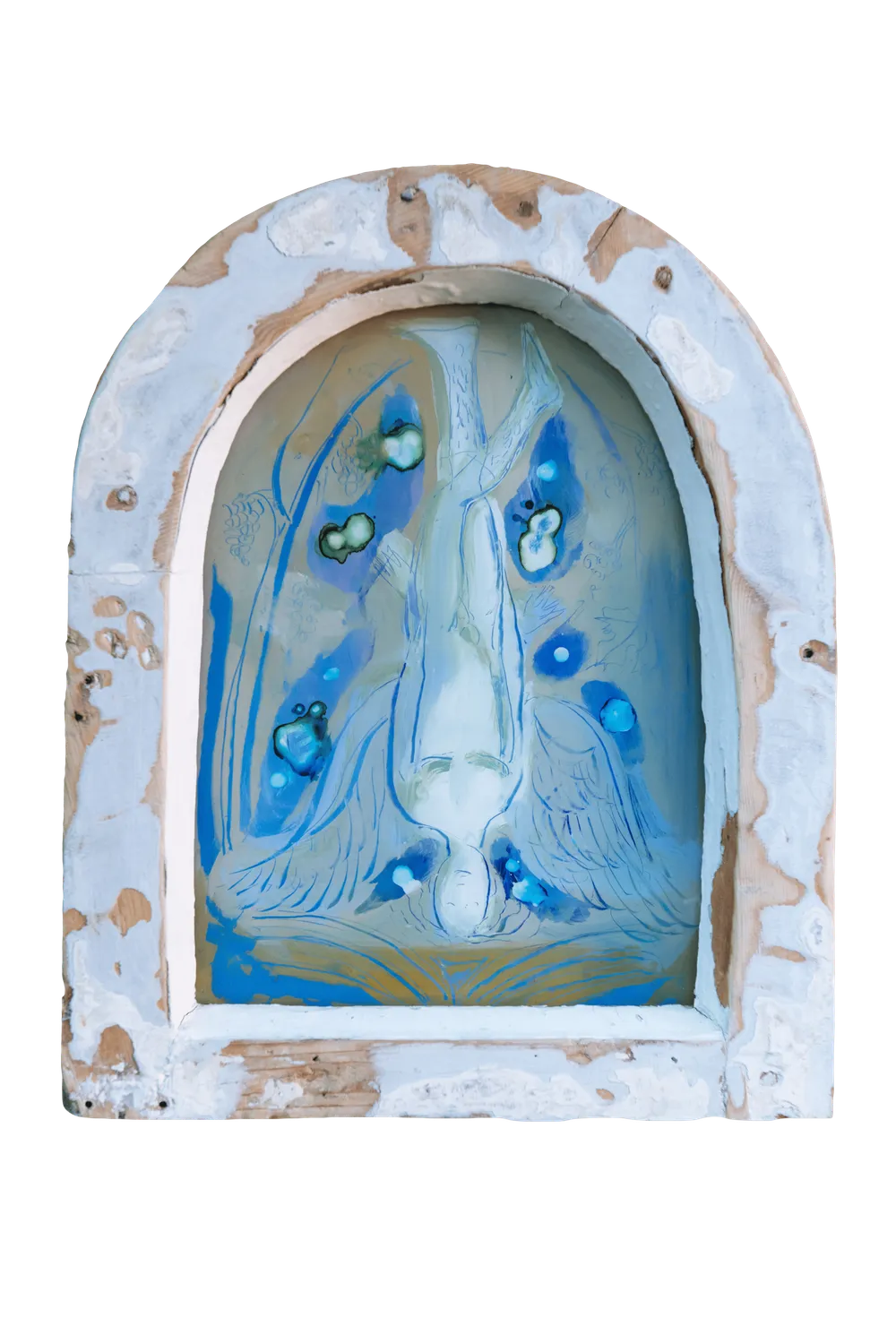
This piece, part of the "Inverted Gardens" series—a collection of drawings on glass created during the war—offers a way to look both outward and inward, serving as a reminder of the fragility and illusory nature of life. What one perceives in the darkness with closed eyes is often more potent and enduring than a gaze through a window. We do not merely see gardens; we cultivate them within our imagination, offering them to the world as a source of joy and enchantment—nurtured through faith and love. In this particular work, an angel stands upon its own wings, head turned downward; perhaps this is the best perspective from which to view a world that is so difficult to comprehend.
Some artists paint what they see. Others paint what they dream. Myroslava Perevalska paints what she feels, and, more importantly, what she fears losing. In a world rushing forward, she is an artist who asks us to slow down, to breathe, to see before the colours fade, before the emotions slip away, before time moves beyond our grasp.
When we spoke, she described her connection to art in a way I had never heard before. “ think of myself as a fish,” she told me. “ fish that doesn’ question the water, that doesn’ think about how deep it swims. It just exists.” Art is her element, her lifeblood, and her way of understanding the world. It’ why, even as war reshapes the reality around her, she continues to create, not just as a form of resistance but as a way to document the truth as she experiences it.
Her paintings are immediately recognisable, figures emerging from bold, urgent strokes of red, white, and black. Red, she told me, is the colour of life, of passion, of survival. It pulses through her work, a constant heartbeat. But it is also the colour she fears losing. “ greatest happiness,” she said, referencing Borges, “ when a blind man dreams of red.” The idea of losing that sensation, of not being able to feel the depth of colour, is her deepest fear. But instead of running from it, she embraces it, pours it into her canvases, ensuring that even if time erodes memory, the intensity of her vision remains.
As we talked, her thoughts spiralled outward - philosophy, history, technology, even the fate of humanity. “ are all on the Titanic,” she told me. “ comfortable but unaware of what’ coming.” The world is changing too quickly. Wars, pandemics, artificial intelligence, isolation. She fears we are forgetting how to truly be present. That people are becoming less human. She sees this loss reflected in modern art, how simple narratives and raw emotion are disappearing, replaced by a detachment from the soul of creation.