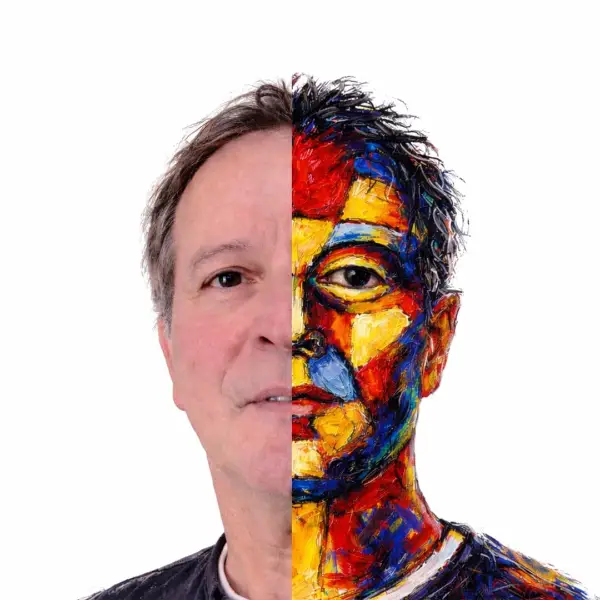
Corre-Pé is a visual artist whose painting explores the human figure as a space of transformation, tension and identity.
The work starts from memory, popular culture and the relationship between symbol, figure and emotion, with themes of everyday life, identity and sharing.
He works essentially with primary colors, red, blue and yellow, as his own language. They are not a decorative resource, they are the matter, the structure and the emotion of the painting. It is through the contrast and the intensity of the primary colors that the figures gain tension, presence and symbolic strength.
The creative process always begins with writing. Before color, there is the Word, before matter, there is thought in its raw state. The text is the invisible structure of the painting, it is not illustrated, it is transfigured into image.
Detached from fixed movements or formulas, he has developed his own language which it identifies as Contemporary Social Art,, with works that seek more than contemplation, they invite reflection, presence and individual interpretation.
What do you see in this artwork?
Contribute your perspective to the community & earn rewards. Leave your reflection below.
Corre Pé
Artist from Portugal
Corre-Pé is a visual artist whose painting explores the human figure as a space of transformation, tension and identity.
The work starts from memory, popular culture and the relationship between symbol, figure and emotion, with themes of everyday life, identity and sharing.
He works essentially with primary colors, red, blue and yellow, as his own language. They are not a decorative resource, they are the matter, the structure and the emotion of the painting. It is through the contrast and the intensity of the primary colors that the figures gain tension, presence and symbolic strength.
The creative process always begins with writing. Before color, there is the Word, before matter, there is thought in its raw state. The text is the invisible structure of the painting, it is not illustrated, it is transfigured into image.
Detached from fixed movements or formulas, he has developed his own language which it identifies as Contemporary Social Art,, with works that seek more than contemplation, they invite reflection, presence and individual interpretation.
What do you see in this artwork?
Contribute your perspective to the community & earn rewards. Leave your reflection below.
THE PHILOSOPHER, THE THEOLOGIAN AND THE NATURALIST
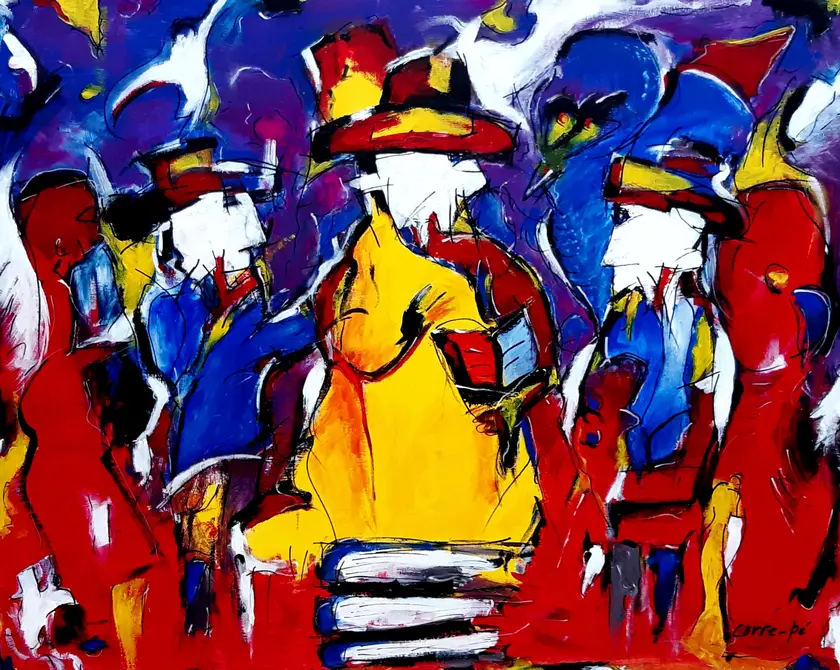
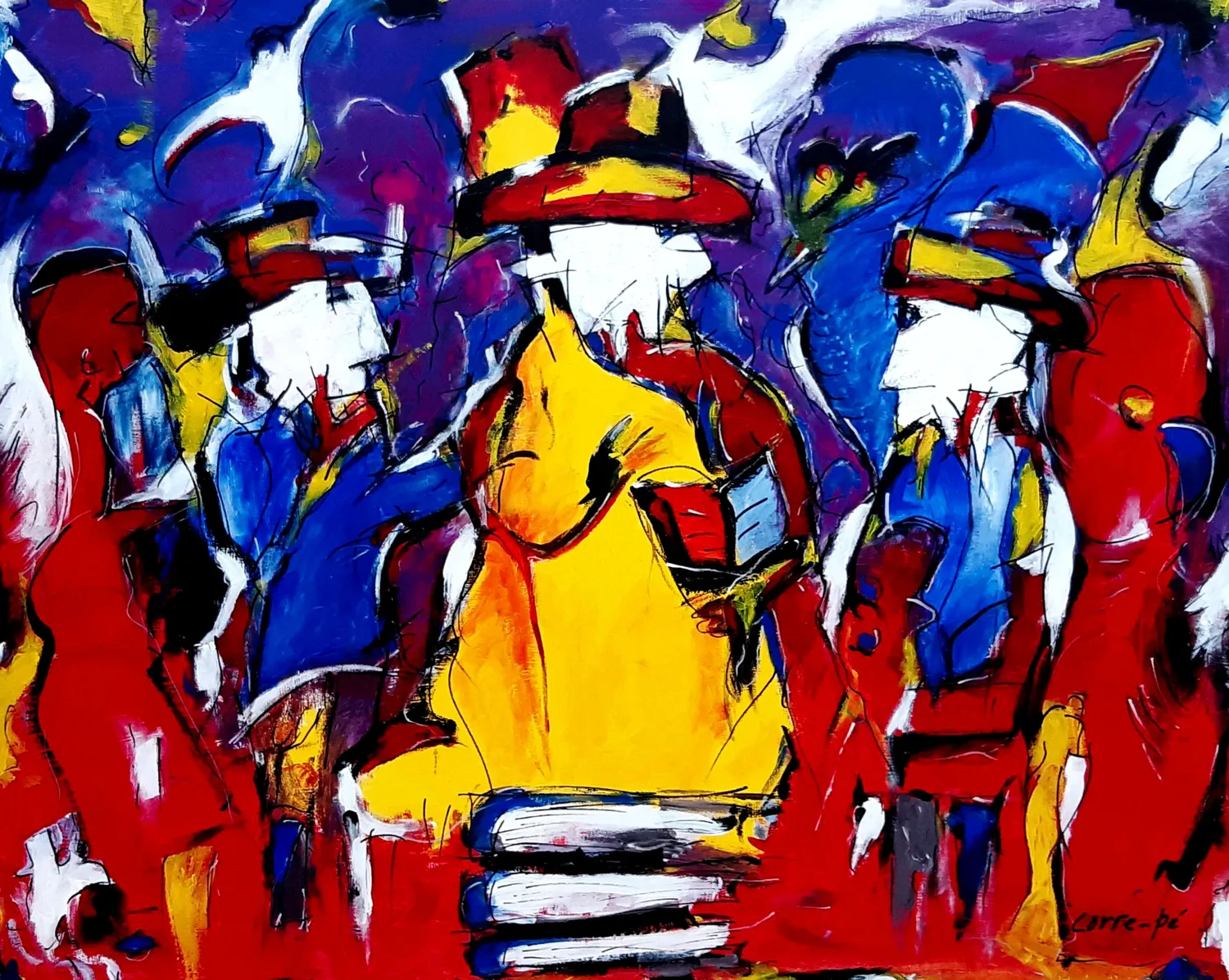
THE PHILOSOPHER, THE THEOLOGIAN AND THE NATURALIST belongs to the Origens series and explores the confrontation of ideas in contemporary society.
At the centre, the philosopher, surrounded by books, represents reason and the search for knowledge. Beside him, the naturalist is surrounded by animals, representing nature and empirical science. On the left, the theologian tries to draw the philosopher into a spiritual debate. Behind him, an ambiguous presence, both angelic and demonic, represents the tension between the sacred and the profane, dogma and interpretation, faith and doubt.
The surrounding figures and symbols enrich an imaginary debate about rules, norms, prejudice and ideologies. Strong primary colors create sharp contrasts and intensify the atmosphere.
The work invites the viewer to reflect on their own convictions and on how they perceive the world around them.
This work was awarded an honorable mention.
Corre-Pé is a visual artist whose painting explores the human figure as a space of transformation, tension and identity.
The work starts from memory, popular culture and the relationship between symbol, figure and emotion, with themes of everyday life, identity and sharing.
He works essentially with primary colors, red, blue and yellow, as his own language. They are not a decorative resource, they are the matter, the structure and the emotion of the painting. It is through the contrast and the intensity of the primary colors that the figures gain tension, presence and symbolic strength.
The creative process always begins with writing. Before color, there is the Word, before matter, there is thought in its raw state. The text is the invisible structure of the painting, it is not illustrated, it is transfigured into image.
Detached from fixed movements or formulas, he has developed his own language which it identifies as Contemporary Social Art,, with works that seek more than contemplation, they invite reflection, presence and individual interpretation.