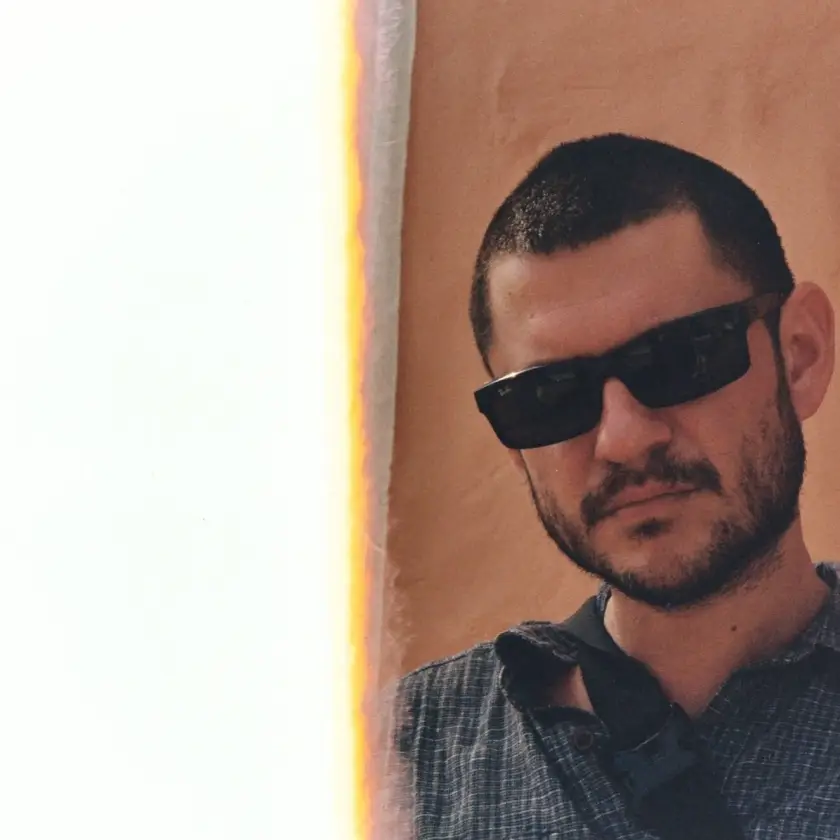
Nicola Iafrate (b. 1990) was born in Bologna, Italy, where he currently lives and works. He began his photographic practice in 2019 after discovering his grandmother’s old Kodak Retina. He later attended a course at the Centro di Fotografia of Spazio Labò in Bologna, where he developed a foundation in analog photography and basic darkroom printing. His practice is rooted in observation and listening, and has led him to cultivate an intimate relationship with outdoor spaces and with the ongoing transformation of landscapes and communities. Over the years, he has developed a deep connection with mountainous environments, which he understands as places of refuge and resistance, both literal and metaphorical. Walking through these spaces becomes a process that continually reshapes his perception of the surrounding world. His photographic research operates at the threshold between natural and anthropogenic landscapes, sustained by a constant introspective approach. His work has been published and exhibited through various independent and international editorial projects.
Look for 20 seconds. What do you see?
Contribute your perspective to the community & earn rewards. Leave your reflection below.
Come una Montagna / Tutto ciò che ci rimane di Sacro
ABOUT THE PHOTOGRAPHER
Nicola Iafrate (b. 1990) was born in Bologna, Italy, where he currently lives and works. He began his photographic practice in 2019 after discovering his grandmother’s old Kodak Retina. He later attended a course at the Centro di Fotografia of Spazio Labò in Bologna, where he developed a foundation in analog photography and basic darkroom printing. His practice is rooted in observation and listening, and has led him to cultivate an intimate relationship with outdoor spaces and with the ongoing transformation of landscapes and communities. Over the years, he has developed a deep connection with mountainous environments, which he understands as places of refuge and resistance, both literal and metaphorical. Walking through these spaces becomes a process that continually reshapes his perception of the surrounding world. His photographic research operates at the threshold between natural and anthropogenic landscapes, sustained by a constant introspective approach. His work has been published and exhibited through various independent and international editorial projects.
Come una montagna / Tutto ciò che ci rimane di sacro
On the persistence of memory and presence
Come una montagna / Tutto ciò che ci rimane di sacro explores memory as an active, unstable process rather than a fixed archive. The mountain appears as a persistent presence—not as landscape, but as a vertical structure through which different temporalities intersect. Walking becomes a method of attention, a way of inhabiting time, where fragments of the past resurface within the present.
The work unfolds through a dialogue between analog landscape photographs, taken during hikes, and images drawn from the artist’s family archive. These materials, separated by almost a century, are not connected through documentary continuity, but through a process of stratification that allows memories and perceptions to overlap. Digital intervention does not conceal the origin of the images; instead, it exposes their coexistence, making visible the act of superimposition itself.
Faces preserved in the family archive reappear within rocks, shadows, and geological forms, generating a subtle correspondence between the living and the absent. The act of photographing the mountain becomes a gesture of passage, where the archive is not recalled but reactivated. Memory, here, does not illustrate the past—it insists within the present.
The resulting images oscillate between presence and apparition. Different temporal layers converge, producing a space that feels suspended, where perception precedes narration. Within the series, verticality serves as an interpretive principle: the verticality of the mountain, the walking body, and the act of being present in the world.
Within the project, landscape photographs and family archive images are presented at full scale, as tangible and structural elements—foundational pillars suspended between verticality and memory. The stratified pictures, by contrast, appear at a smaller scale, marking a further distance: they inhabit an unstable, intermediate dimension, distinct from both the archive and the landscape.
Come una montagna / Tutto ciò che ci rimane di sacro reflects on what remains, what returns, and what continues to orient our relationship with reality, suggesting memory as a form of quiet persistence—embedded in matter rather than recalled through images.
Captions
nicola_iafrate_1
Mount Zeda, Val Grande 2023
Analog photograph, silver gelatin print
nicola_iafrate_2
Family Christmas c.1950s
Family archive photograph
nicola_iafrate_3
Great-grandfather Antonio 1920 / Dolomitic rocks 2024
Analog photograph and family archive, digital stratification
nicola_iafrate_4
Great-grandfather Antonio 1920 / Dolomitic rocks 2024
Analog photograph and family archive, digital stratification
nicola_iafrate_5
Grandma Rosanna and her sister Maria, Muraglione 1937 / Sasso di san Zanobi 2024
Analog photograph and family archive, digital stratification
nicola_iafrate_6
Cingino Lake 2024
Analog photograph, silver gelatin print
nicola_iafrate_7
Grandma Rosanna, 1930s / Monte Vettore 2019
Analog photograph and family archive, digital stratification
nicola_iafrate_8
skiing in Abetone in the 1920s / Val Grande 2024
Analog photograph and family archive, digital stratification
nicola_iafrate_9
Grandma Rosanna and her Granpa, Forlì 1935 / Val Grande 2024
Analog photograph and family archive, digital stratification
nicola_iafrate_10
Bellaria 1930s / Valsesia 2023
Analog photograph and family archive, digital stratification
nicola_iafrate_11
Family portrait 1920s / Valle del Silenzio 2024
Analog photograph and family archive, digital stratification
nicola_iafrate_12
The Stanghellini sisters posing on Gran Paradiso, 1936
Family archive photograph
nicola_iafrate_13
The Stanghellini sisters posing on Gran Paradiso, 1936 / Mount Zeda, 2023
Analog photograph and family archive, digital stratification
Nicola Iafrate (b. 1990) was born in Bologna, Italy, where he currently lives and works. He began his photographic practice in 2019 after discovering his grandmother’s old Kodak Retina. He later attended a course at the Centro di Fotografia of Spazio Labò in Bologna, where he developed a foundation in analog photography and basic darkroom printing. His practice is rooted in observation and listening, and has led him to cultivate an intimate relationship with outdoor spaces and with the ongoing transformation of landscapes and communities. Over the years, he has developed a deep connection with mountainous environments, which he understands as places of refuge and resistance, both literal and metaphorical. Walking through these spaces becomes a process that continually reshapes his perception of the surrounding world. His photographic research operates at the threshold between natural and anthropogenic landscapes, sustained by a constant introspective approach. His work has been published and exhibited through various independent and international editorial projects.
Look for 20 seconds. What do you see?
Contribute your perspective to the community & earn rewards. Leave your reflection below.