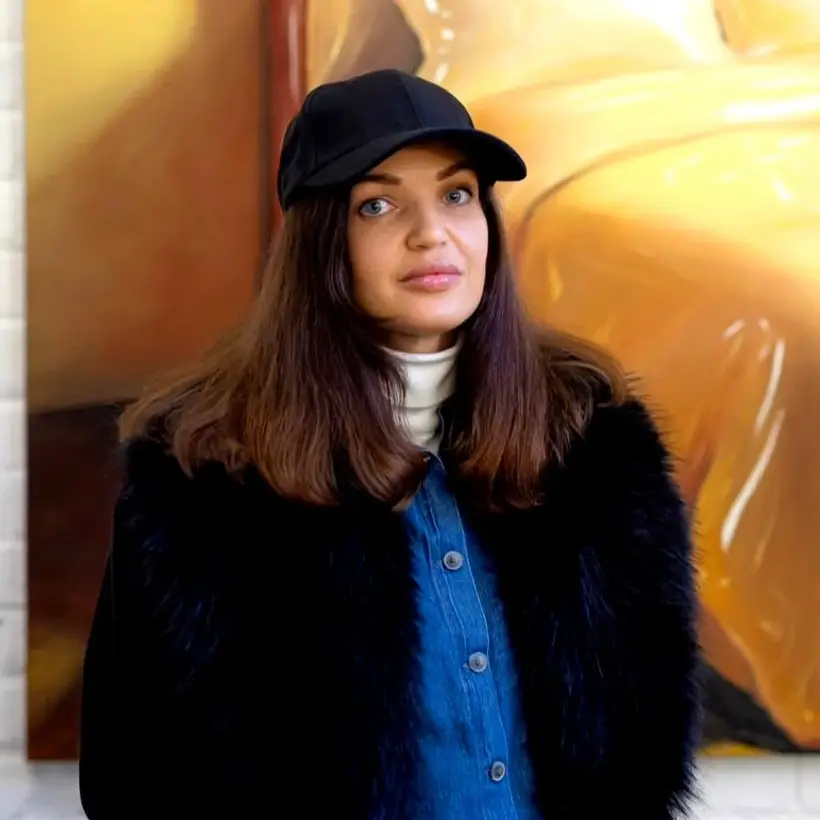
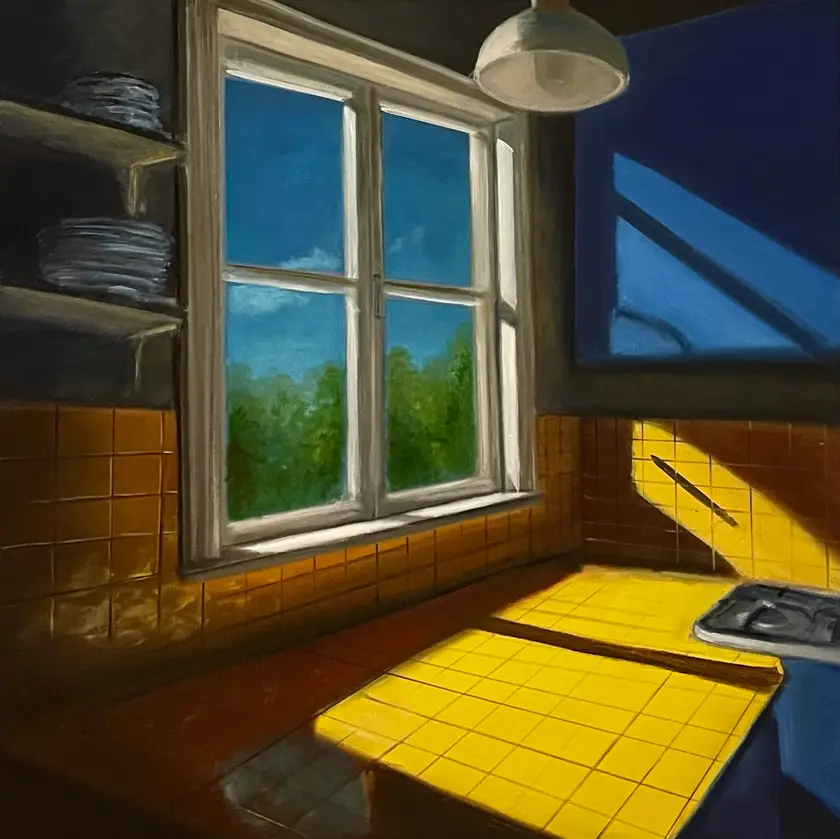
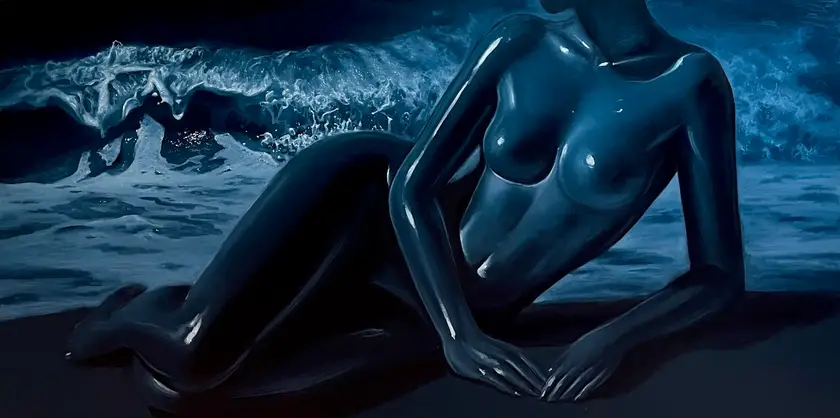
Kryvych is a contemporary interdisciplinary artist from Kyiv. She studied at the Madrid School of Fine Arts and spent two years training in the studio of Ukrainian artist Leo Limanenko. Her practice explores the mechanisms of human interaction with the world, revealing deeper layers of reality, truth, and being. Through her work, she addresses themes of dehumanization, estrangement from nature, and immersion in artificial constructs that distort our connection to the essence of life. She lives and works in Kyiv.
How does this artwork make you feel?
Contribute your perspective to the community & earn rewards. Leave your reflection below.
When I was working on painting « Flowers n°2 », I found myself reflecting on how flowers have been represented through the centuries, how each era gave them different meanings, and how those meanings were tied to culture, emotion, and human imagination. Flowers are never just decorative; they carry ideas, sentiments, and histories with them.
Renaissance (15th–16th c.)
In the Renaissance, flowers appeared in devotional contexts. Leonardo da Vinci’s Benois Madonna shows the Christ Child reaching for a lily held by Mary — a small yet profound symbol of purity, virtue, and divine insight. Every bloom was intentional, a way to reflect on morality, spirituality, and the perfection of nature. Flowers were moral and contemplative markers, woven into religious narratives and the human longing for transcendence.
Dutch & Flemish Golden Age (17th c.)
Moving forward, artists like Osias Beert the Elder introduced abundant, impossible bouquets. Flowers that could never bloom together in the same season were arranged meticulously, sometimes alongside small animals like chickens. These works reflect vanitas themes — the fleeting nature of life, beauty, and luxury — but also the human urge to manipulate, preserve, and idealize nature. Exotic flowers hinted at wealth and curiosity, yet carried undertones of transience and decay. Beert’s work is already playful with time and mortality, foreshadowing the artificiality that synthetic flowers embrace today.
Rococo & Enlightenment (18th c.)
In the Rococo period, flowers became lighter, decorative, and pleasurable. Jean-Baptiste Oudry’s compositions exemplify this shift: bouquets are playful, abundant, and visually charming. The focus moves from moral or vanitas meaning to sensory delight, elegance, and the human fascination with classification, botany, and curiosity. Flowers are celebrated for their forms, colors, and ability to delight the eye, rather than for their allegorical weight.
Baroque / Dutch Mastery – Rachel Ruysch (1664–1750)
Ruysch’s still lifes perfected the impossible bouquet. Cascading arrangements, meticulously rendered flowers, and combinations that could not exist in nature create a tension between hyperrealism and fantasy. Her work celebrates the beauty of life while acknowledging its fragility, presenting an eternal yet ephemeral vision. These impossible still lifes resonate strongly in synthetic forms, where perfection and imagination coexist.
Romanticism & Modernity (19th c.)
During Romanticism, flowers became emblems of sentiment, longing, and love, connected to the “language of flowers.” Pierre-Joseph Redouté’s botanical illustrations combine scientific accuracy with poetic elegance, while Delacroix adds mystical and emotional overtones. Impressionists like Monet and Manet explored color, light, and perception, while symbolists imbued flowers with mystical or erotic resonance. Flowers shifted from moral symbols to vehicles of emotion, perception, and experience.
20th century
Matisse, Georgia O’Keeffe, and Warhol deconstructed flowers in different ways. Matisse - pure color, joy, visual celebration.O’Keeffe - monumental, bodily, sensual forms. Warhol - repetition, mass production, media culture.
Flowers move from natural symbols to conceptual objects, abstractions, and signs, exploring visual, emotional, and cultural meaning.
Contemporary & Synthetic Flowers
Today, with my Flowers n°2, flowers exist beyond biology and mortality. They are hyperreal, glossy, reflective, impossible in nature yet fully present. They echo Ruysch’s “impossible still life,” O’Keeffe’s bodily abstraction, and Warhol’s conceptualization of image and repetition. My flowers carry the memory of centuries of meaning but question what a flower can be in a synthetic, post-natural, conceptual space. They are an eternal extension of what can be considered a living form — blooms that will never fade, existing as perpetual reflections of beauty, perception, and imagination.
Kryvych is a contemporary interdisciplinary artist from Kyiv. She studied at the Madrid School of Fine Arts and spent two years training in the studio of Ukrainian artist Leo Limanenko. Her practice explores the mechanisms of human interaction with the world, revealing deeper layers of reality, truth, and being. Through her work, she addresses themes of dehumanization, estrangement from nature, and immersion in artificial constructs that distort our connection to the essence of life. She lives and works in Kyiv.