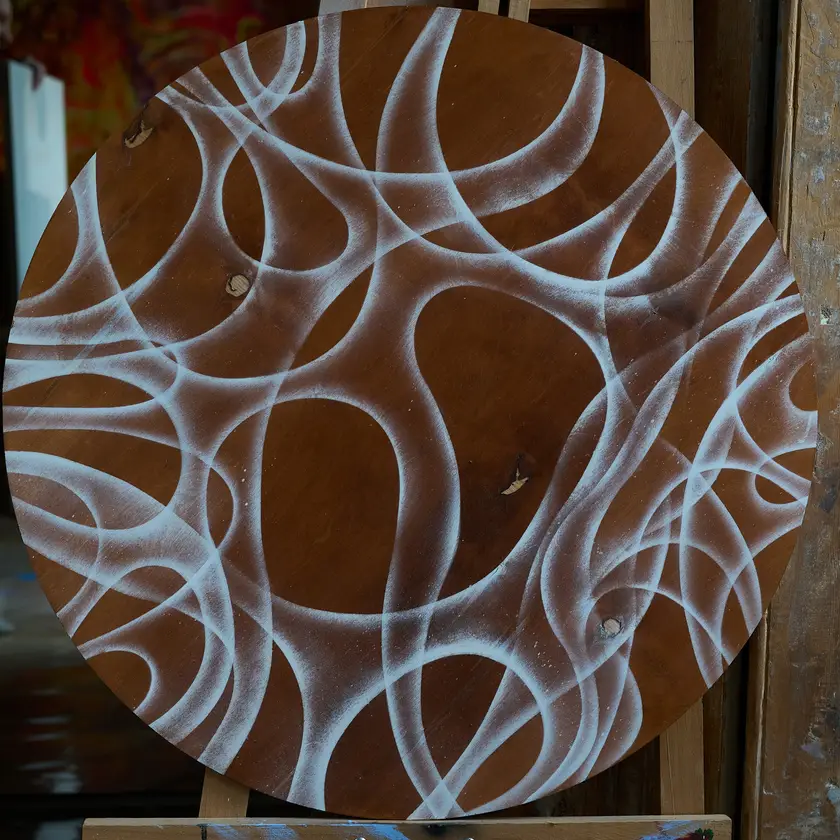
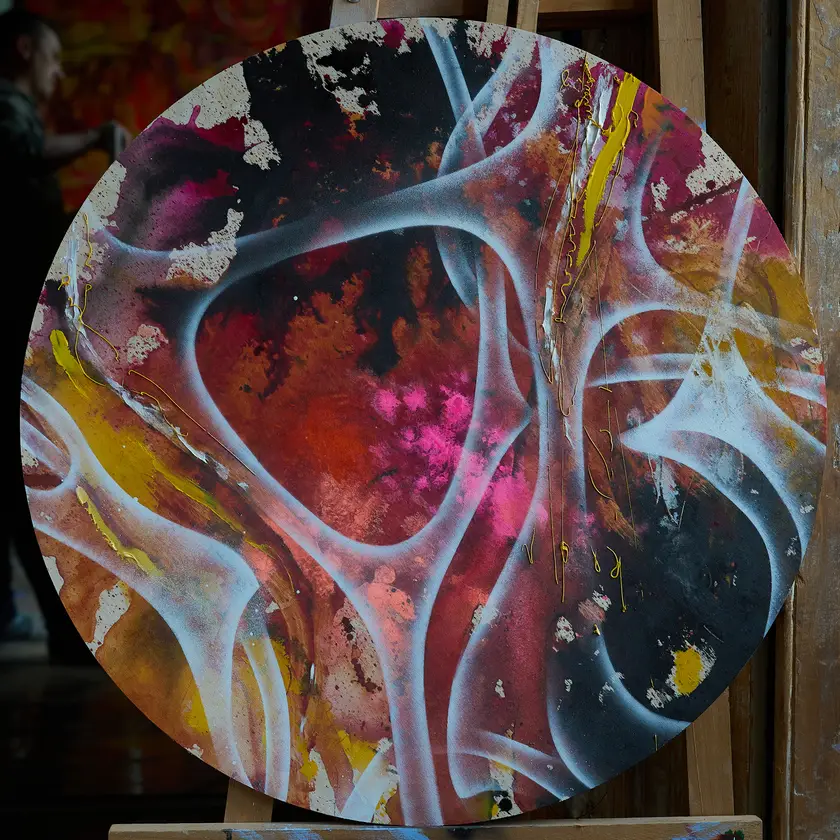
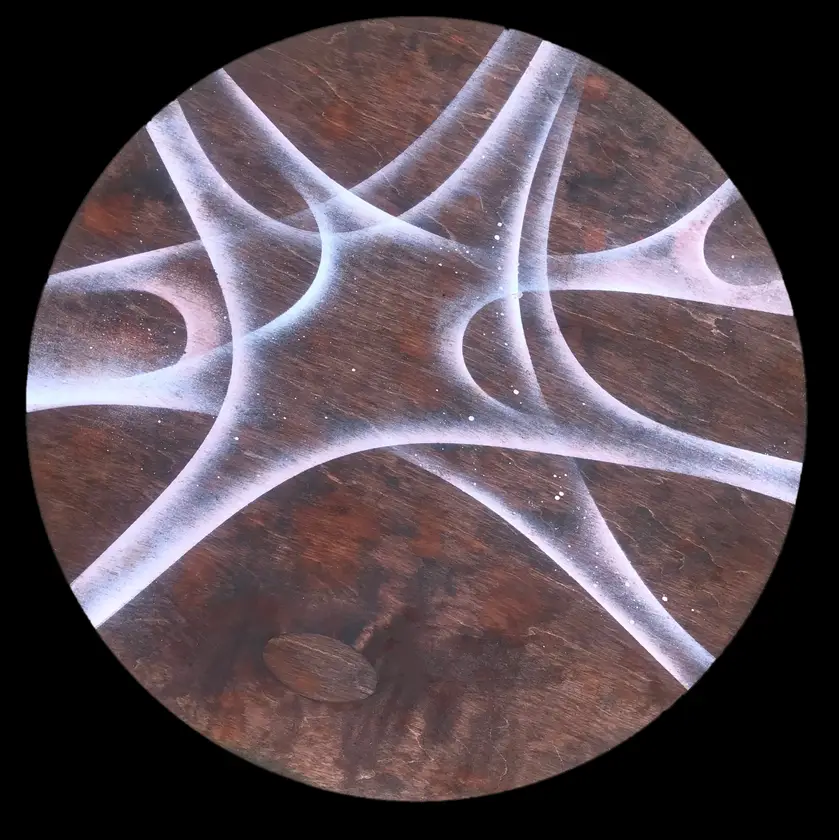
Elnara Nasirli is an Azerbaijani contemporary artist whose practice explores the intersection of environmental technology, biotechnology, and the natural world. Working across installation, sculpture, painting, sound, collage, and mixed media, she creates biomorphic environments that examine relationships between human perception, ecological systems, memory, and transformation.
Drawing on organic structures and natural processes, Nasirli combines reclaimed and unconventional materials with technological and sensory elements. Sound, spatial interventions, and interactive components play an increasingly important role in her practice, transforming her works into evolving environments rather than static objects.
Her artistic research focuses on ecological awareness, resilience, regeneration, and the complex relationships between humans and other forms of life. Through immersive and multisensory experiences, Nasirli explores the boundaries between the natural and artificial, living and non-living, while inviting viewers to reconsider their perception of and connection to the environment.
Whose work did this artwork remind you of?
Contribute your perspective to the community & earn rewards. Leave your reflection below.
The industrial revolution in the petrochemical era made way for the discovery of a whole myriad of new synthetic materials. This allowed to dramatically accelerate production of disposable and durable materials. However, such exponential production also required proper waste management that the world was not equipped for, particularly in the case of treatment of highly toxic chemical waste. Sumqayit, located in Azerbaijan was chosen to be one of the biggest chemical production hubs in the Soviet Union. As a result, in 1960, the biggest petrochemical plant in Europe was built there. The proportion of the production, however, largely surpassed the waste management. This waste leaked into the environment creating a new species of inorganic byproducts as a result new synthetic mutations called - Esteragenes.
These synthetic additions serve as a stark representation of the toxic legacy left behind by Soviet-era petrochemical factories, where chemical pollutants seeped into the environment, giving rise to mutations and deformities in both flora and fauna. The juxtaposition of wood and plastic signifies the clash between tradition and modernization, echoing the ideological struggle that defined the era of decolonization leaving a permanent impact on our genetic landscape.
Elnara Nasirli is an Azerbaijani contemporary artist whose practice explores the intersection of environmental technology, biotechnology, and the natural world. Working across installation, sculpture, painting, sound, collage, and mixed media, she creates biomorphic environments that examine relationships between human perception, ecological systems, memory, and transformation.
Drawing on organic structures and natural processes, Nasirli combines reclaimed and unconventional materials with technological and sensory elements. Sound, spatial interventions, and interactive components play an increasingly important role in her practice, transforming her works into evolving environments rather than static objects.
Her artistic research focuses on ecological awareness, resilience, regeneration, and the complex relationships between humans and other forms of life. Through immersive and multisensory experiences, Nasirli explores the boundaries between the natural and artificial, living and non-living, while inviting viewers to reconsider their perception of and connection to the environment.